
The Labor Code strictly regulates the power of the employer by imposing a limitation period of two months to initiate any proceedings after the discovery of a wrongful act. But how do you react when you are subject to a measure that you consider unfounded or procedurally irregular?
A decision taken lightly or without respecting legal formalities can quickly become a major source of tension within your professional environment. This article details the steps for initiating an abusive disciplinary sanction in order to restore your rights and obtain, if necessary, the annulment of the measure before the competent authorities. We take stock together of the legal levers at your disposal.
- Legal framework for appealing against an abusive disciplinary sanction
- What are the procedural defects and grounds for invalidity?
- 2 key steps to building a strong evidentiary case
- Action before the industrial tribunal and effects of the annulment
Legal framework for appealing against an abusive disciplinary sanction
Contesting a sanction is based on compliance with the disciplinary scale, the ban on fines and the two-month limitation period. Doubt benefits the employee, allowing the cancellation of a disproportionate or discriminatory measure.
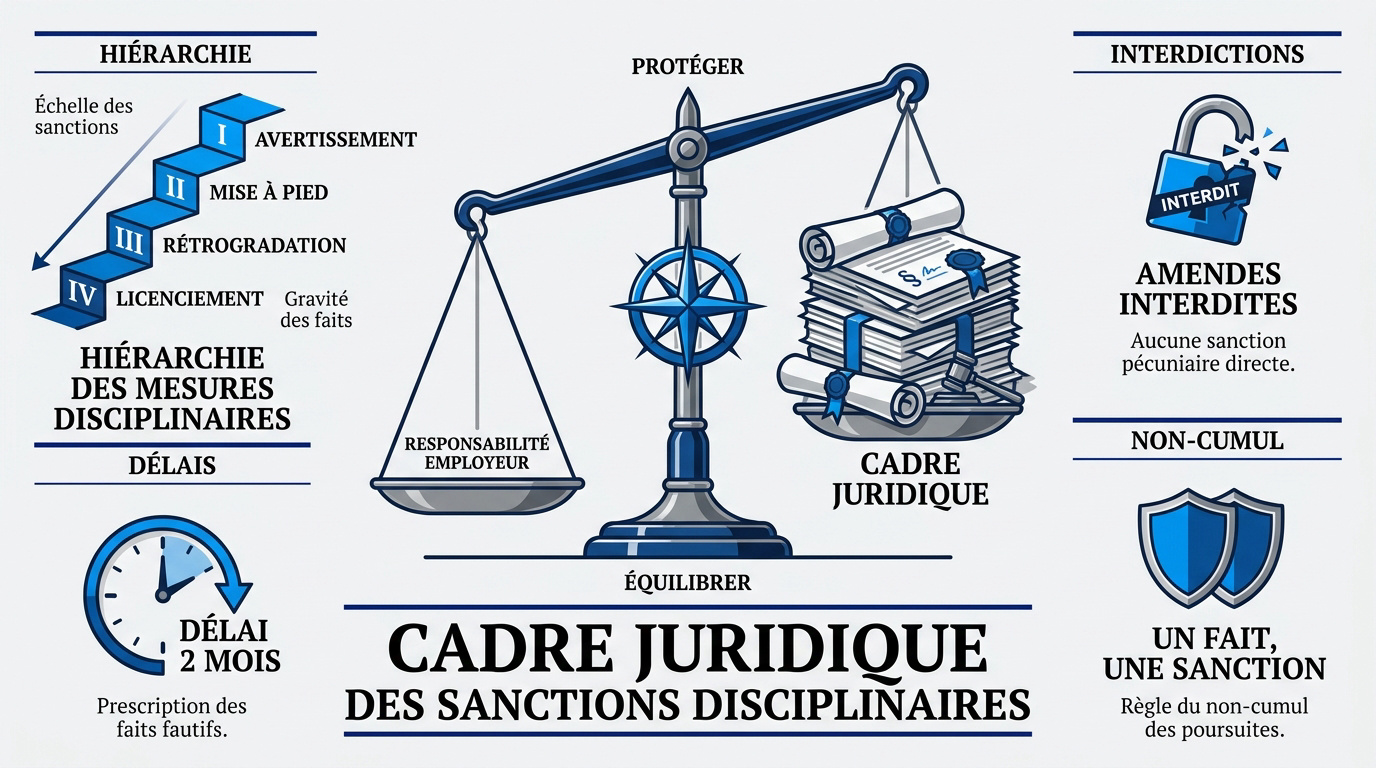
Hierarchy of disciplinary measures and legal prohibitions
The employer must respect a proportionate scale, from warning to dismissal. Each level must be justified by the seriousness of the facts alleged against the employee.
The Labor Code strictly prohibits fines and monetary penalties. The employer cannot touch the salary, this rule constituting an absolute provision of public order.
Any deduction from salary for disciplinary reasons is void. The employee may demand full reimbursement before the competent authorities.
Limitation periods and rule of non-cumulative proceedings
The employer has two months to initiate the procedure after knowing the facts. After this legal deadline, the facts are prescribed and disciplinary action is impossible.
The principle “non bis in idem” prevents the same act from being punished twice. A fault already sanctioned is definitively removed from any further prosecution.
No wrongful act alone can give rise to the initiation of disciplinary proceedings beyond a period of two months from the day on which the employer became aware of it.
To check if you can challenge an unjustified disciplinary action at work, use this quick diagnostic.
What are the procedural defects and the grounds for invalidity?
Beyond the substance, the form of the sanction is just as decisive in obtaining its annulment before the judges.
Minor sanctions (warning, reprimand): simple reasoned letter. Heavy sanctions (transfer, demotion, dismissal): compulsory preliminary interview with right to assistance.
Formality of the invitation and respect for the preliminary interview
The employer must notify the obligatory information in the summons. The subject, date, time and right to assistance are imperative. The omission of a single element renders the procedure irregular.
Compliance with the legal timetable conditions the validity of the decision. Notification must occur between two working days and one month after the interview. Failure to comply with this deadline weakens the sanction.
Carefully review these steps to contest a termination or layoff. A formal error is often enough to invalidate the measurement.
Disproportionate sanctions and protection against discrimination
Consistency between the fault and the measure taken is fundamental. An isolated delay cannot justify a disciplinary dismissal. The sanction must remain strictly proportionate to the alleged grievance.
Certain grounds lead to automatic nullity, in particular discrimination. The right to strike and the protection of whistleblowers are fundamental freedoms. Any infringement of these rights is illegal.
Contesting an unjustified disciplinary sanction at work requires analyzing whether the employer respected these protections. The Industrial Tribunal severely sanctions these breaches by canceling the measure.

2 key steps to building a solid evidence file
To turn these irregularities into a legal victory, you must now build an unassailable defense case.
Drafting of the dispute letter and attempt at conciliation
Structure your factual arguments in a registered letter with acknowledgment of receipt. Respond point by point to the criticisms made by the employer. Be precise, calm and purely factual in your writing.

Then propose a meeting to request an amicable withdrawal of the sanction. Internal conciliation often proves to be quicker than litigation. It sometimes avoids a long and costly legal procedure.
Please note that contesting an unjustified disciplinary sanction requires total administrative rigor. This approach protects your future rights. It officially documents your disagreement with the managerial decision.
Inventory of admissible evidence and testimony
Identify material documents such as professional emails or text messages. This digital evidence is essential in modern litigation. They make it possible to precisely date exchanges and orders received.
The certificate of colleagues must respect strict formalism according to the Code of Civil Procedure. It must be dated, signed and accompanied by proof of identity. Be careful of the limits of undeclared video surveillance, which is often considered inadmissible.
| Type of evidence | Valeur juridique | Condition of validity |
|---|---|---|
| E-mails | Force probante forte | Essential writing and traceability |
| Testimonials | Force probante moyenne | Strict formalism and verified identity |
| SMS | Force probante forte | Respect for the privacy of the employee |
| Activity reports | Force probante forte | Objective and verifiable data |
Action before the industrial tribunal and effects of annulment
If the amicable route fails, legal recourse becomes the final defense to restore your rights and your honor.
Referral to court and reversal of the burden of proof
Referral to the conciliation and guidance office constitutes the obligatory initial phase. During this hearing, the industrial tribunal advisors tried to promote a final agreement. This step is crucial.

The employer has the legal obligation to demonstrate the reality of the alleged facts. The judge reviews the evidence provided by both sides. If uncertainty persists, doubt systematically benefits the employee. It is a protective principle.
To contest a sanction, it is useful to understand the criteria for dismissal for simple misconduct. The evidence remains free before the judges.
Reparation of the damage and removal of the sanction from the file
Retroactive cancellation erases the consequences of the measure on your professional career. The sanction is removed from your personal file. You then find a situation strictly identical to that preceding the unfair decision.
You can request damages to repair moral harm. The magistrate assesses the amount according to the attack on your dignity or the vexatious nature of the procedure. Each situation is sovereignly assessed by the judge.
The cancellation of a disciplinary sanction results in the erasure of all traces of it in the employee’s file.
Faced with a disproportionate or irregular measure, gather your factual evidence to initiate an appeal against an abusive disciplinary sanction. By acting within two years, you can obtain the annulment of the decision and the erasure of your record. Restore your professional integrity and contractual rights now.
FAQ
How quickly can my employee initiate disciplinary proceedings after misconduct?
In accordance with article L1332-4 of the Labor Code, the employer has a period of two months to initiate disciplinary proceedings from the day he has exact and complete knowledge of the alleged facts. After this limitation period, the facts can no longer be the subject of a sanction, under penalty of nullity of the measure.
However, this period can be waived if a new fault is committed within a five-year cycle, thus allowing the employer to invoke a previous fault to justify the gradation of the sanction, provided that the facts are correlated. It is also important to note that no sanction dating back more than three years can be invoked to motivate a new disciplinary decision.
Is a deduction from my salary legal as a disciplinary sanction?
French labor law strictly prohibits financial sanctions. Your employer cannot under any circumstances reduce your remuneration, eliminate a bonus or withhold salary to punish misconduct. Such a practice is considered an absolute rule of public order and any clause to the contrary would be automatically void.
It is nevertheless necessary to distinguish the disciplinary sanction from detention for lack of service provided. If an unjustified absence or lateness can result in a reduction in salary proportional to the time not worked, this does not constitute *a fine but a simple interruption of the work consideration*.
What are the employer’s obligations when summoned to a preliminary interview?
For any sanction having an impact on your career, your duties or your remuneration, the employer must respect rigorous formalities. The summons must be sent by registered letter or delivered by hand against receipt. It must specify the purpose of the interview, the date, time, place, as well as your right to be assisted by a person of your choice from the company’s staff.
Failure to comply with these mandatory information or the absence of a preliminary interview constitutes a procedural defect. At the end of this exchange, the employer is required to respect a reflection period: notification of the sanction cannot take place less than two working days, nor more than one month after the date of the interview.
What are the possible remedies if I consider that a sanction is disproportionate or unjustified?
If you consider that the measure taken against you is excessive in relation to the seriousness of the facts or that it is based on subjective reasons, you can refer the matter to the Industrial Tribunal. The court will analyze the evidence provided by both parties to verify the reality and proportionality of the fault. In the event of persistent doubt, this systematically benefits the employee.
The industrial tribunal has the power to cancel the sanction if it is deemed unjustified, disproportionate or tainted by a procedural irregularity. This cancellation results in the retroactive erasure of the measure in your disciplinary file and may give rise to the award of damages to repair the moral or material damage suffered.
Can you be sanctioned twice for the same wrongdoing?
Under the legal principle non bis in idem, an employer cannot sanction an employee twice for the same wrongful act. Once a sanction has been notified, the employer has exhausted its disciplinary power regarding these specific facts. He cannot therefore decide later to increase the sanction for the same reasons.
Any attempt to accumulate sanctions for a single act makes the second measure illegal. This protection guarantees the stability of your professional situation and prevents any disciplinary action based on events already dealt with by management.
Official sources
The amounts and time limits in these fiches prevail; they are revised.
For a labor-law question, the information service answers on 0 806 000 126 (free service + the cost of a call, Monday to Friday 9:00 – 11:30 and 13:30 – 16:00). This site is an independent directory.